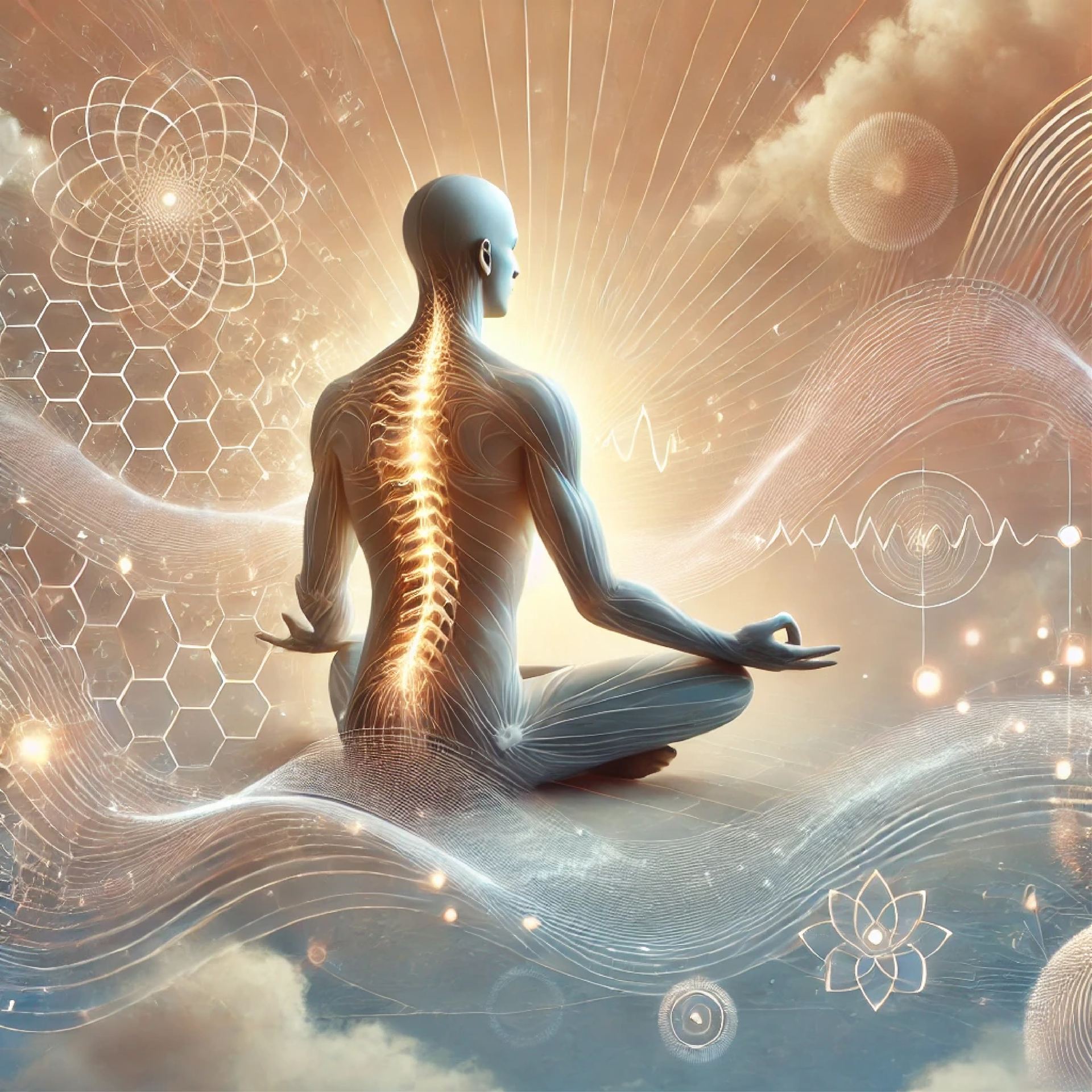
Yes - Quantum Flow can be a meaningful method for stress relief and anxiety management. Here's how the work actually moves.
Nervous system regulation
Quantum Flow works to balance the sympathetic (fight-or-flight) and parasympathetic (rest-and-digest) nervous systems. This balance is foundational to reducing felt stress and anxiety levels - not as a one-off, but as a learnable rhythm.
A holistic approach
The practice incorporates body movement, breathwork, meditation and visualisation. This multifaceted approach addresses stress and anxiety on physical, mental and emotional levels at once - so the relief doesn't have to come from a single direction.
Release of stored stress
Quantum Flow aims to release stress that has settled into the body. Much chronic tension and anxiety lives there, quietly, until something gives it a way out.
Mindfulness and present-moment awareness
The practice cultivates presence - a well-evidenced way to soften anxious thought spirals and let the body catch up to the moment it's actually in.
Energetic alignment
Quantum Flow seeks energetic alignment between heart, mind, body and soul. This alignment can promote a felt sense of calm and balance - the kind that doesn't disappear the moment something stressful happens.
Breath
The method incorporates breathing techniques, well-established as effective for stress and anxiety management.
The benefits of regular practice
Consistent practice tends to grow your capacity. Stress management becomes less effortful, and a baseline sense of wellbeing returns more often.
Accessibility
Quantum Flow can be practised in short 15-20 minute sessions - a real consideration for busy people who want stress relief that fits their day.
Community support
Many Quantum Flow programmes offer access to a community of like-minded practitioners, which can provide additional, quietly powerful support for those navigating stress or anxiety.
"Regulation isn't a one-off. It's a learnable rhythm."
While Quantum Flow is offered as a stress-relief and anxiety management tool, individual experiences vary. For severe anxiety or stress-related disorders, please consult a healthcare professional - this work walks alongside that care, never instead of it.
For further reading on mind-body practices and their effects on stress and anxiety, you may find this helpful: Pascoe, M. C., Thompson, D. R., & Ski, C. F. (2017). Yoga, mindfulness-based stress reduction and stress-related physiological measures: A meta-analysis. Psychoneuroendocrinology, 86, 152-168.
- Connie